
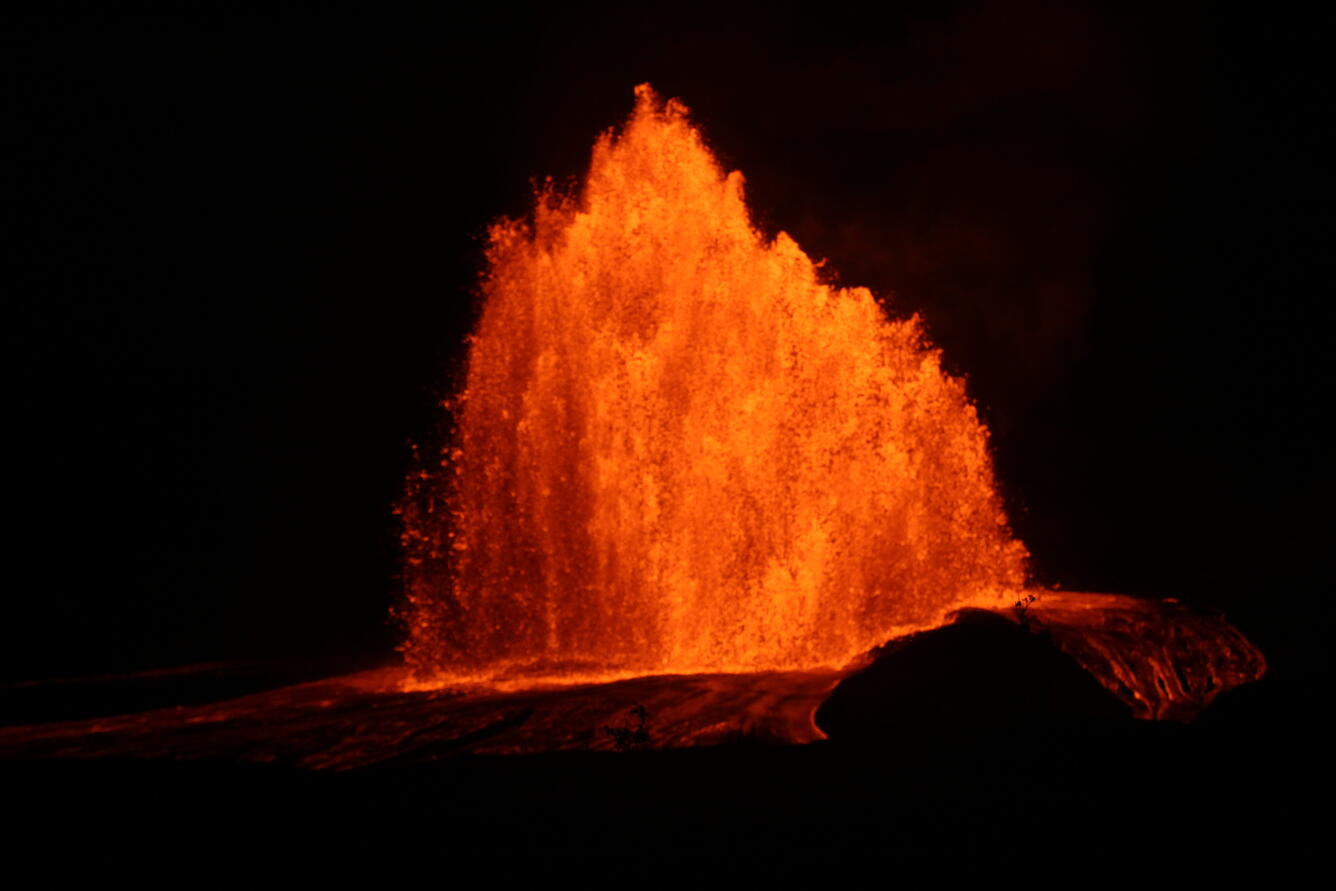
Episode 55 of Kilauea's Halemaʻumaʻu eruption began at 3:19 a.m. HST on Oct. 17 and ended at 9:03 a.m., with a lava fountain peaking near 720 feet. As of Oct. 23, the USGS lists the eruption as paused, at Advisory/Yellow. Its preliminary forecast for episode 56 is Oct. 29 to Nov. 5.
In this article
Kīlauea’s summit eruption in Halemaʻumaʻu crater is paused after episode 55, a burst of lava fountaining on Oct. 17 that peaked at about 720 feet (220 meters), according to the U.S. Geological Survey’s Hawaiian Volcano Observatory (HVO). The observatory’s most recent daily update available when this article was written, dated Oct. 23, says the summit is re-inflating and gives a preliminary window for the next episode.
What happened in episode 55
HVO says episode 55 began at 3:19 a.m. Hawaii Standard Time on Oct. 17 and “ended abruptly” at 9:03 a.m. the same day. In UTC, that is 13:19 to 19:03. The Honolulu Star-Advertiser, citing HVO, described the fountaining as lasting “nearly six hours.” HVO’s Oct. 18 update puts it at 5.7 hours.
The key numbers, all from HVO:
- The maximum fountain height was “approximately 720 feet (220 meters) above ground level” from the north vent, recorded between 4:50 and 5:10 a.m. HST.
- The plume reached about 25,000 feet (7,500 meters) above sea level.
- Preliminary estimates indicate about 9 million cubic yards (7 million cubic meters) of lava erupted. By 8:30 a.m. HST, lava flows covered 75% of the crater floor.
- “Tephra fall was restricted mostly to the closed area of Hawaiʻi Volcanoes National Park, southwest of the active Halemaʻumaʻu vents.”
The Star-Advertiser also reported that, as with the previous 54 episodes, all vents and lava flows stayed confined to Halemaʻumaʻu.
What an “episode” and lava fountaining mean
Kīlauea’s current eruption began on Dec. 23, 2024, and HVO has been counting its bursts of fountaining as numbered episodes. Between those bursts the eruption pauses while the summit magma chamber re-inflates. HVO describes the pattern this way: “Lava fountaining episodes generally lasted for less than 12 hours and were separated by pauses of two or more weeks.” Episode 54 was on Aug. 25, 2026, according to HVO.
In HVO’s reports, a fountain is lava erupting from a vent and rising to a measured height. The fountains also create tephra, which HVO describes as “small glassy volcanic fragments” including volcanic ash, pumice, scoria and Pele’s hair.
HVO tracks the cycle with tiltmeters, instruments that measure how the ground at the summit tilts. During episode 55, a summit tiltmeter recorded 21 microradians of deflationary tilt. HVO says the summit magma chamber “began to rapidly deflate” when fountaining started and returned to inflation when it stopped.
Why episode 55 was unusual
HVO says the run-up to this episode broke the established pattern. It was preceded by 39 days of intermittent overflows, “a record for the length of precursory activity prior to fountaining.” The next longest period of precursory activity was 6 days. During that stretch, new vents opened in Halemaʻumaʻu and a shallow dike was emplaced beneath Kaluapele.
On Oct. 17, HVO offered this interpretation of what triggered the fountaining: vigorous overflows “appear to have purged the system of older degassed magma and allowed more water-rich magma into the conduit.” That wording is the observatory’s assessment, not a settled finding.
Current status and hazards
On Oct. 17, during the episode, HVO listed Kīlauea at alert level WATCH and aviation color code ORANGE. By Oct. 18 it was back at ADVISORY/YELLOW, and the Oct. 23 update says it remains there. The Oct. 23 update also reports:
- Glow was observed overnight from the north and west vents; none from the south vent, which was covered in tephra during episode 55.
- Low-level seismic tremor continues, which HVO calls “typical during inter-episode pauses.”
- Summit sulfur dioxide emissions typically run 1,000 to 5,000 tonnes per day during pauses. HVO’s Oct. 17 update said they typically reach 100,000 tonnes per day during fountaining.
- The East Rift Zone and Southwest Rift Zone show low seismicity and ground deformation.
HVO says eruptive activity since December 2024 has taken place within a closed area of Hawaiʻi Volcanoes National Park, but “recent intrusions highlight that the location of eruptive activity could change.” Its listed primary hazards are volcanic gas (including sulfur dioxide and the vog it forms downwind), tephra, lava flows and ground cracks. The Halemaʻumaʻu crater rim area has been closed to the public since late 2007. For visitor information, HVO points to the National Park Service.
What happens next: a forecast, not a schedule
HVO’s Oct. 23 update gives a “preliminary forecast for episode 56 fountaining” of “between October 29 and November 5, 2026.” The Oct. 21 update had given October 28 to November 5, so the window has already shifted by a day.
The forecast is based on modeling of inflationary tilt, and HVO attaches a caveat: “given the differences in the run-up to episode 55, there is uncertainty in whether inflation will remain regular and predictable allowing forecasts with reasonable precision.” In other words, the dates are an estimate that could change. HVO says it continues to monitor Kīlauea closely. HVO’s Oct. 18 update said more data was needed to make a forecast and that it was uncertain whether future episodes would return to predictable patterns.
Where to watch and follow official updates
HVO’s updates list its Kīlauea resources, including three summit livestreaming cameras on the USGS YouTube channel, the USGS Kīlauea webcams page and the photo and video chronology. Daily updates and volcano notices are posted on the USGS volcano notice system, and you can subscribe at volcanoes.usgs.gov/vns2. This article does not embed any video, and the file photo in this article is from an earlier episode.
Sources
- U.S. Geological Survey, Hawaiian Volcano Observatory: Daily Update, Oct. 23, 2026 (accessed Oct. 24, 2026)
- U.S. Geological Survey, Hawaiian Volcano Observatory: Daily Update, Oct. 21, 2026 (accessed Oct. 24, 2026)
- U.S. Geological Survey, Hawaiian Volcano Observatory: Daily Update, Oct. 18, 2026 (accessed Oct. 24, 2026)
- U.S. Geological Survey, Hawaiian Volcano Observatory: Daily Update, Oct. 17, 2026 (accessed Oct. 24, 2026)
- Honolulu Star-Advertiser: Kilauea lava fountaining ends after nearly 6 hours in Halemaumau crater (Oct. 17, 2026; accessed Oct. 24, 2026)

Every fact in this article is checked against its source before publication. Editorial standards