
The USGS measured a magnitude 7.0 earthquake in Tibet's Nagqu region at 10:33 p.m. local time on Oct. 22, at a depth of 18 km. Chinese authorities report 16 dead and 76 injured. The Central Tibetan Administration cites reports of at least 20 deaths, unverified.
In this article
A magnitude 7.0 earthquake struck Baqen County in the Nagqu region of Tibet, which China calls Xizang, at 10:33 p.m. local time on Thursday, Oct. 22 (14:33 UTC), according to the U.S. Geological Survey (USGS). Chinese authorities say 16 people died and 76 were injured. Tibet is largely inaccessible to foreign journalists, so those figures cannot be independently verified.
What happened
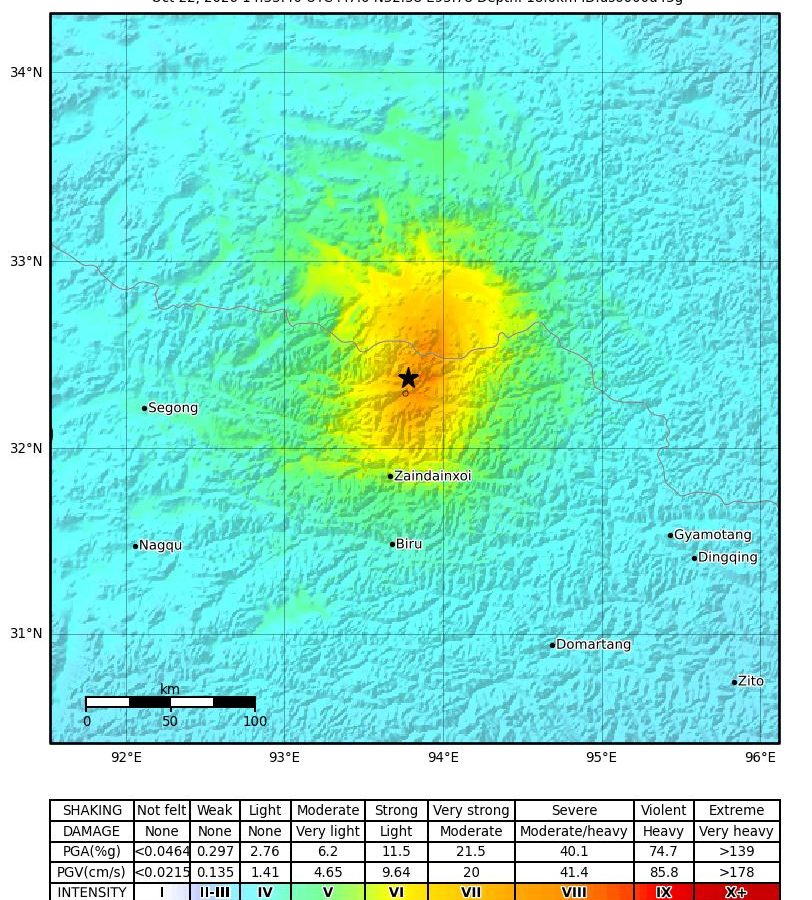
The USGS placed the epicenter 191 kilometers east-northeast of Nagqu, at a depth of 18 kilometers. The agency’s reviewed solution gives a moment magnitude of 7.0. ABC News Australia, in an AP and Reuters report, called it the strongest earthquake to hit China since January 2024.
The shaking hit a remote plateau. The Chinese state outlet Global Times, citing media reports, said the epicenter lies 399 kilometers from Lhasa at an average altitude of about 4,800 meters, with a sparse population nearby. State broadcaster CCTV aired footage of collapsed houses and shattered stone walls, ABC News reported.
Latest figures, and where they differ
Official numbers come almost entirely from Chinese state media. Place names also vary between sources: Chinese outlets mostly write Baqen, AFP’s report spelled it Baqing, and the Central Tibetan Administration (CTA), an exile body whose statement is dated Dharamshala, says Drachen.
- Chinese authorities: 16 dead and 76 injured, according to local authorities quoted by Xinhua. AFP, citing Xinhua, said 11 of the injured are in serious condition. An earlier update from the city’s emergency management bureau, reported by CGTN early on Friday, counted 46 injured, so the injury figure rose during the day. The death toll of 16 was unchanged in reports published through Oct. 24.
- Damage and displacement: 339 homes and 20 livestock sheds were damaged or destroyed, according to the Nagqu city information office. As of 10 a.m. Friday, 12,489 residents had been evacuated. After three rounds of door-to-door checks, no missing persons had been reported as of 6 p.m. Friday, the emergency command headquarters said.
- Central Tibetan Administration: The CTA says preliminary reports from sources it called credible indicate “at least 20 people have lost their lives,” and that at least 10 deaths were reported in one village, Kamlung Gal. These figures are the CTA’s own, not confirmed by Chinese authorities or by any independent outlet we have seen. The CTA statement also notes the official toll of 16.
It is not clear from the CTA statement whether its count includes the 16 deaths Chinese authorities have confirmed. We are therefore reporting both figures with their sources and not combining them.
The USGS issued an orange alert for economic losses and a yellow alert for shaking-related fatalities in its PAGER system, and estimated that approximately 111,000 people experienced moderate to severe shaking. It noted that homes in the region are mostly vulnerable adobe block and unreinforced brick-and-mud structures, though more resistant buildings exist.
Why it happened
The USGS tectonic summary says the earthquake was caused by normal faulting within the Tibetan Plateau, on a crustal fault dipping moderately to either the northwest or the southeast. The plateau is seismically active because of India-Eurasia convergence: the India plate collides with and underthrusts Eurasia, which drives uplift of the Himalaya and the plateau.
That uplift creates the unusual stress pattern behind this quake. According to the USGS, the plateau is the highest in the world and is currently extending to the east and west because of its high gravitational potential energy. The agency compares it to a pile of honey spreading flat after being poured. The USGS says the normal-faulting mechanism of this earthquake is consistent with that east-west extension.
The USGS adds that 29 earthquakes of magnitude 7.0 or larger have occurred within the plateau and along its bounding regions since 1900. A magnitude 6.9 earthquake on April 13, 2010, 272 kilometers east-northeast of this one, caused more than 2,500 deaths. The agency says impacts in this sparsely populated region vary widely depending on how close the rupture is to population centers.
Aftershocks and what happens next
The USGS catalog lists 16 aftershocks of magnitude 4.0 or greater within 150 kilometers of the mainshock through 08:39 UTC on Oct. 24. The first large one, a magnitude 5.2, came about 38 minutes after the mainshock. The largest so far is a magnitude 5.3 on Oct. 24. The USGS says aftershocks, some potentially with strong shaking, may follow.
Officials told journalists they were concerned about further building collapses from aftershocks and about casualties from rockslides, ABC News reported. Xinhua said rockfalls forced the closure of a section of National Highway 317 to all but emergency vehicles, and communications were down in some areas. More than 5,000 personnel have been deployed to the relief effort, according to Xinhua, and intermittent snow is expected over the next three days.
President Xi Jinping said rescuers “must go all-out to carry out search-and-rescue operations,” Xinhua reported, as quoted by AFP. Chinese authorities have also allocated 50 million yuan in central disaster relief funds, according to Xinhua.
Anyone who felt the earthquake can report it through the USGS “Did You Feel It?” survey on the event page. Official updates on casualties will come from Chinese authorities; this article will need updating as those figures change.
Sources
- U.S. Geological Survey, “M 7.0 – 191 km ENE of Nagqu, China” event page, including Key Points, Tectonic Summary and PAGER comments (accessed Oct. 24, 2026)
- U.S. Geological Survey, earthquake catalog query for aftershocks within 150 km (accessed Oct. 24, 2026)
- China Daily (Xinhua), “Rescue efforts intensify after Xizang quake kills 16, injures 76” (accessed Oct. 24, 2026)
- CGTN, “16 killed after M7.0 quake hits China’s Xizang, rescue efforts underway” (accessed Oct. 24, 2026)
- Global Times, “All-out rescue and relief underway after 7.0-magnitude quake hit Xizang’s Baqen” (accessed Oct. 24, 2026)
- ABC News Australia (AP/Reuters), “Rescuers search for survivors after deadly earthquake in China’s Tibet” (accessed Oct. 24, 2026)
- Taipei Times (AFP), “China orders all-out rescue after quake in Tibet kills 16” (accessed Oct. 24, 2026)
- Central Tibetan Administration, “STATEMENT: Devastating Earthquake in Drachen County, Nagchu, Tibet” (a party to the dispute over Tibet; figures unverified) (accessed Oct. 24, 2026)

Every fact in this article is checked against its source before publication. Editorial standards